✦ Now welcoming new patients · Same-day emergency appointments where possible · Afterpay, SuperCare & all major health fundsBacchus Marsh · (03) 8001 7008
Myobrace for Bacchus Marsh kids: habits first, teeth second.
Crooked teeth in children often start with habits nobody notices: breathing through the mouth, a tongue that rests low, or a swallow that pushes forward. Myofunctional therapy with the Myobrace® system uses soft, removable appliances and short daily exercises to work on those habits while your child’s jaw is still growing. Children aged about 3 to 15 are usually considered at our Gisborne Road clinic.
MMyobrace® in Bacchus Marsh · Magical Smiles, 83 Gisborne Road
Removable appliances · Daily exercises · An assessment before any recommendation
Caring for families across Bacchus MarshMaddingleyDarleyHopetoun ParkMerrimuBallanMeltonMooraboolCaring for families across Bacchus MarshMaddingleyDarleyHopetoun ParkMerrimuBallanMeltonMoorabool
What you might be noticing
A list of small things that often arrive together.
Most parents don’t come in asking about “myofunctional therapy.” They come in because their child breathes through their mouth at night, sucked a thumb for years, or has new front teeth arriving crowded. On their own, these things can seem minor. Together, they often point to the same habits — how a child breathes, where their tongue rests, and how they swallow. Snoring on its own is common: a Royal Children’s Hospital Melbourne fact sheet (reviewed March 2018) says up to 20% of children snore, but only around 3% have obstructive sleep apnoea. If your child snores, mention it at the assessment; your GP can advise on sleep and breathing too.
“If we wait another year and nothing changes — the same habits, the same crowding coming through — what would that actually look like?”
01Sleeps with their mouth open, or breathes through the mouth during the day.
02Breathes noisily or snores at night.
03Sucked a thumb or dummy well past the toddler years.
04Pushes the tongue forward against the teeth when swallowing.
05Rests with the lips apart and the tongue sitting low.
06Has a narrow upper jaw, with little room for the adult teeth.
07Front teeth are coming through crowded, with no space to spare.
08The upper and lower teeth don’t quite meet the way they should.
3 — 15
Ages usually considered for Myobrace
1–2hrs
Daytime wear, plus overnight while sleeping
1–3
Years of treatment is typical for most children
Daily
Short exercises for lips, tongue and breathing
Causes, not symptoms
Crooked teeth are usually a symptom, not the cause.
Crowded teeth are often shaped by what happens around them: thumb-sucking, tongue thrusting or mouth breathing can all affect how teeth come through and line up. Myobrace aims at those habits rather than the teeth alone.
Explaining the why before the what.
Three habits influence how the upper jaw develops — how a child breathes, where their tongue rests, and how they swallow. Each is small on its own, but they happen all day, every day, through the years a child is growing.
The Myobrace® system works on these habits with a series of soft, removable appliances and daily exercises. Rather than moving teeth directly, the way braces do, it aims to support healthier jaw development while your child is still growing.
01 / Habit
Mouth breathing
A child who breathes mainly through their mouth rests with their lips apart and their jaw dropped. The upper jaw, normally supported from inside by the tongue and from outside by closed lips, can develop narrower as a result — and that can affect facial growth and how the teeth line up.
02 / Habit
Low tongue posture
The tongue should rest gently against the roof of the mouth. When it sits low instead, the upper jaw loses that support from inside, the arch can grow narrower, and there’s less room for the adult teeth still waiting to come through.
03 / Habit
Incorrect swallow
A correct swallow draws the tongue up against the palate. An incorrect swallow — often called a tongue thrust — pushes forward against the front teeth instead. Repeated over years, that forward pressure can affect how the teeth come through and how the bite develops.
The why of early
A window that’s widest while still growing.
Bone responds differently at six than at sixteen. While a child is still growing, Myobrace® works with that growth — encouraging nasal breathing and good tongue posture so the upper jaw has the chance to develop with more room for adult teeth. Once growth slows, Myobrace® has less to guide, and straightening usually relies more on braces or aligners.
At our Bacchus Marsh clinic, Myobrace sits within our children’s dentistry care, alongside first visits, check-ups and bulk-billed eligible care.
Before. During. After.
A long-term plan, one stage at a time.
Myobrace is a commitment for the whole family. Treatment usually runs one to three years, and consistent daily use of the appliance and exercises is a big part of how well it works. Here’s how the journey usually looks, from the first assessment to life after treatment.
01 / Before
AssessmentThe first step
A registered dentist looks at how your child breathes, where their tongue rests, how they swallow, and how their jaw and teeth are developing, to see whether Myobrace suits them — now, later, or not at all.
A consultation before any recommendation
Growth patterns checked early
Honest advice on whether to start now or wait
02 / During
TreatmentUsually 1 — 3 years
Your child wears a soft Myobrace® appliance for 1–2 hours each day and overnight, does short daily exercises, and comes in regularly so we can check progress and fit.
A series of Myobrace® appliances as things change
Daily lip, tongue and breathing exercises
Regular check-ins to track progress
03 / After
AfterwardsRetention & review
Once active treatment with Myobrace® ends, your dentist may recommend a retainer to help hold the changes, and will keep monitoring as your child grows. Some children still need braces or aligners afterwards.
Ongoing check-ups after Myobrace®
A retainer, if one is recommended
Braces or aligners only if they’re still needed
Results vary with age, growth and how consistently the appliance and exercises are used. We’ll talk through what’s realistic for your child at the consultation, with no obligation to go ahead.
The system we use
Myobrace® — a habits-first approach to orthodontics.
Myobrace® is a system of removable oral appliances, not a single device. Children wear a series of soft mouthpieces for 1–2 hours during the day and overnight while sleeping, alongside daily exercises that retrain breathing, tongue posture and swallowing. Each Myobrace® stage is chosen for where your child is up to, and the aim is to address the habits behind crowded teeth rather than move the teeth directly.
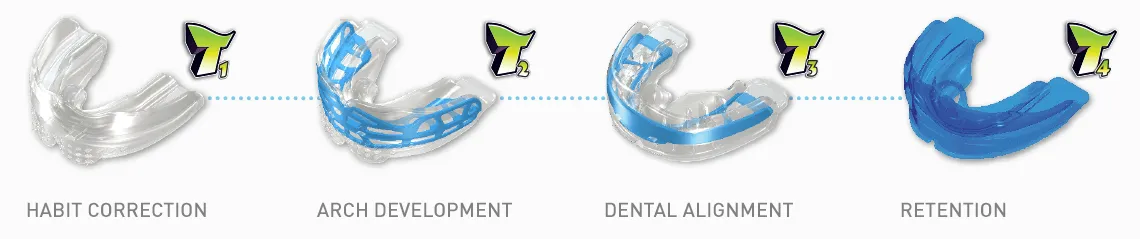
Myobrace® appliance sequence — image courtesy of Myofunctional Research Co.
The system uses a series of appliances across four stages: habit correction · arch development · dental alignment · retention.
The appliance + the activities
Soft. Removable. Worn at home and overnight — and the exercises matter just as much.
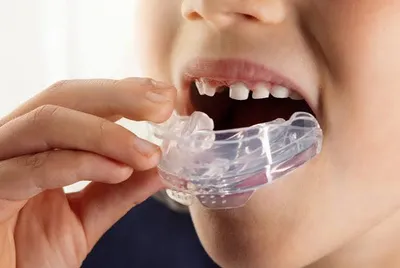
Each stage of the Myobrace® system uses a different appliance, worn for 1–2 hours during the day and overnight while sleeping. It comes out for meals, snacks and sport. Most children find it feels unusual or bulky at first and get used to it within a few days to a week.
The appliance isn’t the whole story. Your child also does short daily Myobrace® exercises to practise keeping their lips together, breathing through the nose and swallowing properly. Doing them together as a family helps them become part of the routine rather than a chore.
Consistent daily use is one of the biggest factors in how well treatment works. We’ll talk openly at the consultation about what your family can realistically manage.
What the first visit actually looks like
Before anything is recommended — a proper assessment.
A Myobrace® consultation doesn’t commit you to anything. A registered dentist needs to assess your child before anything is recommended, and the answer might be Myobrace, braces later on, waiting and watching, or a referral.
01 / Listening
Listening, first.
We start with what you’ve noticed at home — breathing, sleep, eating, habits like thumb-sucking, and whatever brought you in. Your child is welcome to sit on your lap while we talk.
02 / Looking
A gentle look.
We look at how your child breathes at rest, how their lips and tongue sit, how they swallow, where the adult teeth are coming through, the shape of the upper jaw and the bite. Nothing invasive, and X-rays only if there’s a clinical reason.
03 / Explaining
A plain conversation.
If Myobrace looks likely to help, we’ll explain why, what the path involves and roughly how long it takes. If it doesn’t, we’ll say so — and if braces, another approach or a referral would suit better, that’s what we’ll recommend.
04 / Your decision
No pressure to decide today.
Most families go home and talk it over. You’ll get a written plan and cost estimate, including the option of waiting and reviewing later. There’s no rush from our end.
Self-selecting, no pressure
This probably is for you if — and probably isn’t if —
Myobrace® isn’t the right answer for every child. We’d rather you have a good sense of fit before you book, not at the chair.
This is for you
This is probably for you if…
·You’re a parent of a child aged about 3 to 15 who mouth-breathes, sucked a thumb for a long time, or has crowded teeth coming through.
·You’d like to address the habits behind crooked teeth, not just straighten them later — which is what Myobrace® is designed for.
·Your child is still growing, so there’s growth for Myobrace® to work with.
·Your family can commit to daily wear, overnight use and short exercises.
·You’re happy to come in for regular check-ins while treatment progresses.
·You want a dentist who’ll be honest about whether it suits your child, including saying no when it doesn’t.
Probably not
This probably isn’t for you if…
·You’re looking for a quick fix — Myobrace is gradual and usually takes one to three years.
·Daily wear and exercises won’t realistically fit your household right now — that’s fine, and it’s reasonable to wait.
·The concern goes beyond habits and growth — some problems can’t be addressed this way alone, and we’ll tell you if another option suits better.
·You want a finished result without daily effort — Myobrace® relies on the appliance being worn, and the Myobrace® exercises being done, every day.
·You’d prefer to go straight to braces or aligners — that’s a valid path too, and we can talk you through it.
Common questions, plain answers
Things people actually ask.
Myobrace is usually considered for children aged about 3 to 15, while their jaws are still actively developing. The earlier habits are addressed, the more growth there may be to work with, so younger is often easier than older.
It isn’t a hard cut-off. A Myobrace® assessment looks at your child’s growth, habits and teeth, not just their age. If growth has largely finished, Myobrace® alone may not be the right tool, and we’ll talk about braces or aligners instead.
Sometimes, but not always. Myobrace® addresses the habits and growth patterns that often lead to crooked teeth. Working on them early may reduce the need for more extensive orthodontic treatment later, but some children still need braces or other treatment afterwards. We’ll talk through realistic expectations at the consultation.
Usually one to three years, depending on your child’s age, how their jaw is developing, and how consistently the appliance and exercises are used. Some children need 12 to 18 months; others need two to three years.
Children who are still growing and have habits such as mouth breathing, thumb-sucking, tongue thrusting or an incorrect swallow, or who have a narrow upper jaw, crowded teeth or a developing bite problem. Families also need to be ready for daily Myobrace® wear and exercises. A consultation with a registered dentist is needed to confirm whether Myobrace® suits your child.
Usually 1–2 hours during the day, plus overnight while sleeping. It comes out for meals, snacks and sport, and should be stored in its case whenever it’s not being worn.
It can feel unusual or bulky at first, like any new mouthpiece, and some children notice mild tenderness in the jaw or teeth early on or after moving to a new appliance. This usually settles within a few days to a week. If discomfort continues, call us so we can check the fit, rather than skipping wear.
Consistent use is one of the biggest factors in how well Myobrace® works, and inconsistent wear can mean treatment doesn’t achieve what it’s meant to. That’s why we talk openly at the consultation about what your family can realistically manage. If now isn’t the right time, waiting is a reasonable answer.
We don’t quote a price before an assessment, because the right path varies from child to child. After the assessment you’ll get a written plan and cost estimate, with no obligation. Health fund cover depends on your policy’s orthodontic benefits, and we can give you an itemised plan to check with your fund. Services Australia lists orthodontic dental work among the services the Child Dental Benefits Schedule won’t cover (page last updated 1 January 2026), so Myobrace sits outside it. The CDBS may still cover your child’s general check-ups if they’re eligible: up to $1,158 over two calendar years, or $1,132 if their two-year period began in 2025 (Services Australia, page last updated 15 April 2026). Payment plans may be available, subject to approval.
When a child breathes through their mouth, their lips rest apart and their tongue tends to sit low instead of resting against the roof of the mouth. The upper jaw, which the tongue helps shape from inside, can develop narrower as a result, leaving less room for adult teeth. Encouraging nasal breathing and good tongue posture while a child is growing may help support the jaw’s development.
Book a consultation at Magical Smiles Bacchus Marsh, 83 Gisborne Road, or call us on (03) 8001 7008. If your child hasn’t been to us before, our first visit page explains how we start. We’ll assess, explain what we find, and give you a clear next step, with no pressure to commit on the day.
Visit us in Bacchus Marsh
Myobrace at our Bacchus Marsh clinic.
Myobrace® consultations and treatment are available at our Gisborne Road clinic, Monday to Saturday. Book online, call us, or start with a first visit if your child hasn’t been to us before.
Need help affording care? SuperCare may be an option.
SuperCare is an external service that helps with superannuation access in limited circumstances, where specific financial hardship criteria may be met. Eligibility is decided by the ATO, not by our clinic. Accessing super has significant long-term implications for your retirement, so independent financial advice is essential first.
Book a Myobrace® consultation at Magical Smiles Bacchus Marsh, 83 Gisborne Road — or call and we’ll talk you through Myobrace® before you decide. Payment plans may be available, subject to approval.