Eating textures that feel hard
Gagging on lumpy food, refusing meat or bread, packing food in the cheeks, or eating very slowly. The tongue plays a quiet role in how children learn to chew and swallow.

A dentist, speech pathologist or GP may have mentioned it, or you've noticed something at mealtimes. This page explains what a tie is, how our Bacchus Marsh dentists assess it, and what's involved if release is recommended. Nothing here asks you to decide before the assessment.
Assessment first · not every tie needs release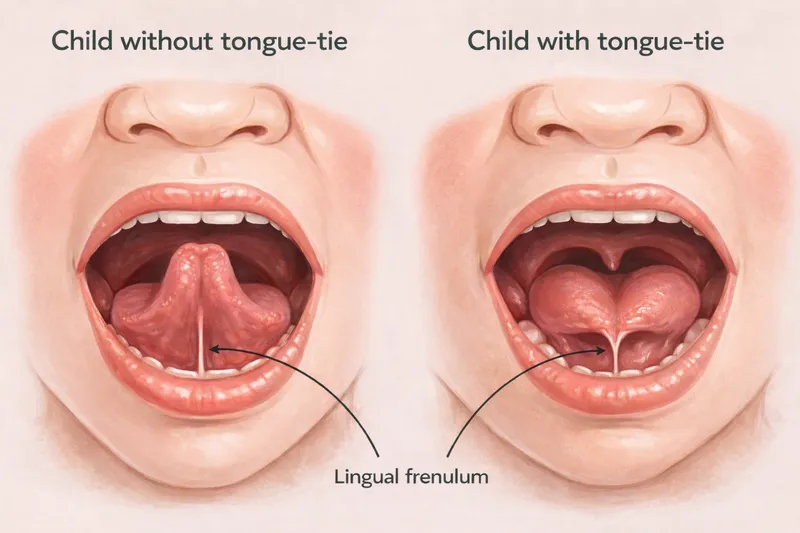
Diagram is illustrative and general — anatomy and severity vary between individuals.
The lingual frenulum is the thin band of tissue under the tongue. In most mouths it's loose enough for the tongue to lift and stretch freely. When it's shorter, thicker or attached further forward, it can restrict how the tongue moves — that's what people mean by a "tongue tie." A similar band under the top lip can restrict the lip instead, which is a lip tie.
Anatomy alone doesn't decide anything. What matters is whether the restriction is causing a problem, so a tie is assessed clinically and functionally before release is even discussed.
Official health guidance says the same. The Victorian Government's Better Health Channel (reviewed 4 August 2026) says tongue-tie may improve on its own by age two or three, and that most breastfeeding problems are not caused by tongue-tie. Healthdirect (last reviewed January 2026) adds that some tongue-ties cause no problems at all: babies feed and older children talk normally.
None of these on its own confirms a tie, and plenty of eating and speech difficulties have other causes. They're simply the signs that often lead a family to ask.
Gagging on lumpy food, refusing meat or bread, packing food in the cheeks, or eating very slowly. The tongue plays a quiet role in how children learn to chew and swallow.
Ongoing trouble with 'r', 'l', 's' or 'th' — sounds that need the tongue tip to lift. Speech pathology leads; release is only considered when restriction is clearly part of the picture.
A persistent gap between the upper front teeth, held by a thick band of tissue under the lip. It's often something to consider when planning orthodontic treatment.
A tight band under the upper lip that may contribute to a gap between the front teeth or food getting trapped.
For a baby, the first step is a phone call rather than an online booking. Call our Bacchus Marsh team on (03) 8001 7008, Monday to Saturday from 9:00 am to 5:00 pm, and tell us what you've noticed — how your baby feeds, rests and settles. We'll talk through the right next step with you, including whether our clinic is the right place for your baby's assessment.
We'll be straight with you about what can and can't be answered over the phone. The rest of this page explains what an assessment involves and how a release is decided, so you know what that conversation might cover.
Pregnancy, Birth and Baby, a service funded by the Australian Government (last reviewed August 2023), notes that tongue-tie doesn't always mean a baby needs treatment, and that for many babies the tissue loosens as they get older. If feeding is hard, your doctor, a maternal and child health nurse or a lactation consultant can help too.
The release itself is brief. Most of the time goes into getting the assessment right, making sure you understand the options, and showing you the aftercare you'll do at home.
We ask what brought you in, about any speech or eating concerns, and what you've noticed at home. There's no rush, and you're welcome to bring a support person.
We check how well the tongue lifts and moves side to side, listen to speech where relevant, and look at the teeth and gums. If a speech pathologist, orthodontist or GP has seen your child, bring along anything they've told you.
We explain what we found, whether release is clinically indicated, what to expect and the alternatives — including doing nothing. Ask us about fees and payment options at any time.
The Wand delivers local anaesthetic at a steady, controlled rate to numb the area. Everyone in the room wears protective eyewear.
Once the area is fully numb, the laser part is usually quick. In most cases there's no scalpel and no stitches.
Your dentist shows you the gentle stretches to do at home, gives you aftercare instructions, and explains how healing and movement will be checked.

We don't rush appointments or use words that might create unnecessary worry. Instruments are introduced slowly, and each step is explained in words your child understands. Parents can stay close if that helps.
For numbing, Magical Smiles Bacchus Marsh uses The Wand, which is designed to make injections feel less noticeable.
Principal Dentist Dr Rachna Yadav's professional development includes the Untangling Tongue Ties Advanced Course, SOSforTOTS and Laser Surgery training, and Dental Laser Safety Officer training.
This is the parent's version. The full clinical page — how the laser works, the Fotona LightWalker system, and each step of the appointment — is at Laser Tongue & Lip Tie Release.
For everything else we do for kids — first visits, check-ups, bulk-billed eligible care and Myobrace — start at our children's dentistry page.
Ask anything else when you call — we'd rather you ring with twenty questions than book unsure.
Book a consultation when it suits you, or call first if your child is a baby. We'll assess carefully, explain plainly, and only recommend release if it's clinically indicated. A consultation doesn't commit you to treatment.