
On this page
- Key points at a glance
- What are natural-looking veneers, and what can they help with?
- How is the right colour and translucency chosen?
- How do veneers handle light like natural teeth?
- Why does surface texture make a difference?
- Why does the fit at the gum line matter?
- Will veneers feel natural when you bite and speak?
- How does digital technology help make veneers?
- Thinking about veneers in Bacchus Marsh?
The aim of natural-looking veneers is simple: teeth that still look like your own, with the chips, stains or gaps you’d like to change taken care of. Getting there comes down to a handful of details, from colour and translucency to the way light moves through a veneer and how neatly it meets your gums.
In short: natural-looking veneers are custom-made to match the colour, translucency and texture of your own teeth, finished to reflect light like enamel, and fitted precisely at the gum line. They also have to work with your bite, so your dentist checks function as carefully as appearance.
Key points at a glance
- Veneers are thin, custom-made shells of porcelain or composite resin that cover the front of your teeth.
- They can address chipped, discoloured, uneven or slightly crooked teeth, with minimal tooth preparation compared with crowns.
- Colour and translucency are matched carefully, sometimes with several shades within one tooth.
- Veneers reflect and scatter light in a similar way to natural enamel, which helps them look lifelike.
- Fine surface texture and a precise fit at the gum line help veneers blend in and support healthy gums.
- A good fit takes your bite and jaw movement into account, so veneers work as well as they look.
- Digital imaging and CAD/CAM design help plan and make veneers precisely.
What are natural-looking veneers, and what can they help with?
Dental veneers are thin, custom-made shells that cover the front surface of your teeth. They’re made from porcelain or composite resin and colour-matched to blend with your natural teeth.
- What they can address: discoloured, chipped or broken teeth, uneven teeth, and mild cases of crooked teeth or alignment issues.
- Made for you: your dentist customises the shape, size and colour of each veneer to suit your teeth and your preferences.
- Minimal preparation: veneers need less tooth preparation than restorations such as crowns, which preserves more of your natural tooth structure and helps keep the tooth strong.
- Durability: with proper care, veneers are durable, and they’re made to resist surface stains and wear. Regular brushing, professional cleans and check-ups all help them last.
Choosing between porcelain veneers and composite veneers, and understanding the costs involved, starts with a consultation. Your dentist can talk you through the options that suit your teeth, and you can read about our payment options beforehand.
As at September 2026, porcelain veneers at our Bacchus Marsh clinic start from $1,700 each and composite veneers from $695 per tooth. Those are starting points, so ask for a written quote after your assessment. You’re not alone in weighing up the cost: in the ABS Patient Experiences survey for 2024–25, released in November 2025, 16.1% of people aged 15 and over said cost was a reason they delayed or did not use dental professionals when they needed to.
How is the right colour and translucency chosen?
Matching colour is part science, part artistry. Healthy teeth aren’t one flat shade: they show subtle gradations of colour and translucency that reflect light differently, and veneers need to copy that to blend in with your existing teeth.
- Assessment: your dentist looks at the colour and translucency of your teeth and how light interacts with their surfaces.
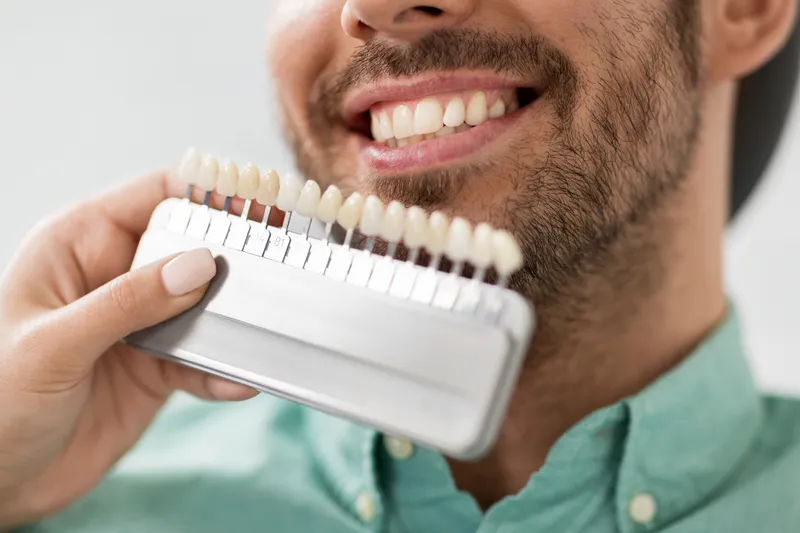
- Colour matching: a shade guide is used to match the veneers to your natural teeth. Sometimes several shades are chosen to copy the gradations within a single tooth.
- Translucency: your dentist assesses how light passes through your natural teeth, so the veneers don’t look too opaque or too translucent.
- Personalisation: your skin tone, facial features and personal preferences all shape the design, along with the type of veneer that suits you.
Digital imaging and shade-matching technology support this with precise measurements and visualisations, and careful layering of high-quality materials helps the finished veneers look natural.
How do veneers handle light like natural teeth?
When light hits a natural tooth, some of it is reflected from the surface and the rest passes into the enamel and is refracted. Veneers are designed to behave the same way, which is a big part of why a well-made veneer looks lifelike rather than flat.
- Surface reflection: the outer layer reflects light much like a natural tooth surface, giving a glossy, lifelike finish.
- Polishing: veneers are polished during fabrication to the right level of surface gloss.
- Internal scattering: light scattering inside the veneer creates the depth and translucency you see in natural teeth.
- Material: porcelain and composite resin each affect how light is refracted, and materials are chosen for their ability to mimic the way light behaves in enamel.
- Layering: veneers are often built up in layers to copy the multi-layered structure of a natural tooth, with each layer reflecting and refracting light slightly differently.
- Matching: because each veneer is custom-made and matched in colour and translucency, light behaves in a similar way across your veneers and neighbouring teeth.
These properties are considered carefully during fabrication, so your veneers blend with your natural teeth and suit your face.
Why does surface texture make a difference?
Natural enamel isn’t perfectly smooth. It has tiny grooves and ridges that scatter light and give teeth their characteristic sheen. Copying that microtexture helps a veneer look natural rather than glassy.
- Copying enamel: porcelain veneers can replicate the fine textures of natural teeth, which changes how they reflect light.
- Custom texturing: dental technicians add fine surface detail to match your own teeth.
- Consistency: keeping texture consistent across your veneers and natural teeth gives a cohesive, even smile.
- Individual detail: everyone’s teeth have their own texture, and dentists and technicians account for this when making custom veneers.
Why does the fit at the gum line matter?
Where a veneer meets your gum is one of the key details for a natural look, and for gum health. Veneers are designed to follow the natural emergence profile of your teeth, which is the way each tooth emerges from the gum, so the transition looks smooth.
- A natural look: a precise, flush fit avoids noticeable edges or gaps at the gum line and stops veneers looking bulky.
- Healthy gums: poorly fitting veneers can leave spaces where plaque and bacteria collect, leading to gum inflammation or infection.
- Easier cleaning: veneers that sit well against the gum line are easier to clean, which lowers the risk of gum disease.
- Comfort: a good fit leaves fewer places for food to get trapped, reducing irritation.
- Staying put: veneers that fit snugly are less likely to be dislodged or damaged.
Getting this right depends on careful custom design and precise placement by your dentist. It’s also a good reason to talk through what you’d like, and any concerns, at your first consultation.
Will veneers feel natural when you bite and speak?
They’re designed to. Natural-looking veneers aren’t only about appearance: they need to work in harmony with your bite and jaw movement, so they feel comfortable and don’t get in the way of chewing or speaking.
- A detailed assessment: before designing veneers, your dentist assesses your dental health, your bite and how your jaw moves.
- A custom fit: each veneer, porcelain or composite, is made to fit your teeth and gums.
- Designed around your bite: veneers are shaped with your bite and jaw movement in mind, to avoid discomfort or strain.
- Fine-tuning: once the veneers are placed, your dentist makes any adjustments needed for fit and comfort.
- Easy to keep clean: well-fitted veneers have a smooth surface that’s simple to brush and floss around, which helps prevent gum disease and tooth decay.
Regular check-ups let your dentist keep an eye on your veneers and your oral health over time, and you’ll get care instructions to help your veneers last. As at September 2026, a standard check-up, scale and clean at our clinic typically ranges between $180 and $280, depending on your needs and any X-rays. Our guide to living with veneers day to day covers eating, sport and cleaning.
How does digital technology help make veneers?
Two technologies play a big part: digital imaging, which captures your teeth in detail, and CAD/CAM (computer-aided design and computer-aided manufacturing), which uses those images to design and make veneers.
- High-resolution scanning: digital scanners capture detailed images of your teeth, gums and mouth.
- Accurate design: those images allow precise measurements and a detailed picture of how the veneers will fit and look.
- CAD/CAM design: software turns the images into a 3D model that can be adjusted for shape, size and colour.
- Manufacturing: once the design is final, veneers can be made from porcelain or composite resin with a high level of precision and consistency.
- A quicker process: these technologies streamline fabrication, which can shorten the time it takes to make and place veneers.
- Comfort: a precise fit helps reduce irritation and supports a comfortable bite.
Materials keep developing too, and 3D printing is an emerging way to make veneers with even more detailed customisation. At Magical Smiles Bacchus Marsh, 3D digital imaging supports treatment planning, including taking digital impressions.
Thinking about veneers in Bacchus Marsh?
Natural-looking veneers come from attention to detail: matching colour and translucency, handling light like enamel, copying texture and fitting precisely at the gum line, all while working with your bite. You can also read how veneers can be part of a smile makeover.
If you’d like to know whether veneers suit you, the Magical Smiles team at 83 Gisborne Road, Bacchus Marsh, can talk you through your options. Call (03) 8001 7008 or book an appointment online.
Frequently asked questions
Several details working together: colour and translucency matched to your own teeth, a surface that reflects and scatters light the way enamel does, fine texture that copies natural tooth surfaces, and a precise fit at the gum line. Each veneer is custom-made for your teeth.
Veneers are made from porcelain or composite resin. Both can be colour-matched to your natural teeth, and the material affects how light passes through the veneer, which is one reason your dentist talks through the options with you.
Veneers need minimal tooth preparation compared with restorations such as dental crowns. That preserves more of your natural tooth structure and helps maintain the strength of the tooth.
Your dentist assesses the colour and translucency of your teeth and how light interacts with them, then uses a shade guide to match the veneers. Sometimes several shades are used to copy the natural gradations within a single tooth. Your skin tone, facial features and personal preferences are considered too.
Properly fitted veneers shouldn’t interfere with chewing or speaking. Your dentist assesses your bite and jaw movement before designing them, and makes any adjustments needed for fit and comfort once they’re placed.
About the author

Our locations
Magical Smiles has locations in Caroline Springs, Bacchus Marsh and Point Cook.